
Drilling Waste Management
Why Choose PDF for Drilling Waste Management?
We provide cost-effective and optimum solutions from environmentally acceptable procedures to achieve zero-discharge plans and improve fluid recovery. The outcome reduces operational costs and enables recycling.
Wastes are analyzed for various parameters such as chloride, nitrate, phosphate, BOD (Biological Oxygen Demand), COD (Chemical Oxygen Demand), and oil content.
Other analysis is carried out to monitor treatment processes regularly during waste generation. Our waste management personnel are fully trained, experienced, and have the competencies in place to provide the best reliable services with concentrated support and the least liabilities.
Integrated Wastewater Treatment & Sludge Dewatering System
Waste Water Treatment
- Recycling the water phase of the waste by high-performance dewatering process
- Dewatering of generated waste
- Supplying rig water by recycling water
- Generating drilling fluid by recycling water
- Reducing the water consumption by monitoring
- Reducing the cost of dumping wastewater
- Preventing environmental costs
Dewatering Unit
- Manufactured by PDF
- Automatic chemical preparation and dosing units
- Stainless steel polymer Unit with touch PLC Control Panel
- Recovery of the liquid phases from the waste mud
- Reduction of waste volume and transportation.
- Electrical shock protected and full safety system and equipment
Sludge Separation Unit
- Manufactured by PDF
- Separate the liquid (filtrate) from the sludge and collect the solids in chambers
- Filter plate with long life and high performance
- Highly effective and filters cake between 40% to 70% solids by weight
- Beneficial due to production of the highest content of solid material, which makes for cost-effective transportation and disposal
Drilling Cutting Treatment
Cutting treatment is an important part of the waste management services to protect the environment and health due to contamination.
Cutting treatment process is designed based on Drilling Fluids type, Environmental constraints, and Client requirements.
PDF offers a wide range of cutting treatment methods according to new and advanced technology, and provides or manufactures all necessary equipment for OBM.
Common Cutting Treatment Technology
Cutting Dryer System
Solidification and stabilization (S/S)
Thermal Treatment Plant
Bio Remediation
1. Cutting Dryer System
The internal cone rotates at a high speed of 900RPM and generates a centrifugal force of 430G.
For the density difference between liquid and solids, mud is hurled out of the surface of drilling cuttings and passes through screens, and solids are retained inside the screens, then liquid is discharged from the liquid outlet, and dry solids are discharged from the bottom of the equipment.
For oil-based and synthetic-based mud, the oil and water content of solids treated by the vertical centrifuge is below 6%.
For water-based mud, the water content of solids treated by the vertical centrifuge is within 5%~8%.

2. Solidification & Stabilize (S/S)
- Solidification
Refers to techniques that encapsulate the waste in a monolithic solid of high structural integrity. In this treatment, material is added to reduce free water and possibly reduce or slow potential contaminant release. Contaminant migration is restricted by vastly decreasing the surface area exposed to leaching by isolating the wastes within an impervious capsule.
- Stabilization
Refers to those techniques that reduce the hazard potential of wastes by converting contaminants into their least soluble, mobile, or toxic form. The physical nature and handling characteristics of the waste are not necessarily changed by stabilization.

3. Thermal Treatment
- Used for OBM cuttings
- High temperature vaporizes oil and water
- The liquid is separated from the solids
- Oil and water are condensed later in the treatment process
- Low oil on cuttings ratio of <1%
- Ensures compliance with any onshore disposal methods
4. Biodegradation Cutting Treatment
With the continued development of the drilling industry and the growing need for environmentally sustainable practices, various methods have been developed worldwide for the treatment and management of drilling cuttings. Each treatment method offers specific advantages and limitations, depending on the characteristics of the waste and the operational requirements.
Among these methods, biodegradation has emerged as an environmentally friendly approach for treating drilling cuttings. The effectiveness of biodegradation depends largely on the type of drilling fluid used, the composition of the cuttings, and the prevailing environmental conditions. This method is generally carried out through the following approaches:
Advantages
- Use of microorganisms
- Combination with fertilizers and farming
- Using hydrocarbon worms
- Eco-friendly
- Preserve the soil
- Reduce pollution
Disadvantages
- Time consumption and space occupation
- Sensitivity to environmental conditions
- Inefficiency with changes in drilling fluid and formations
Environmental Laboratory
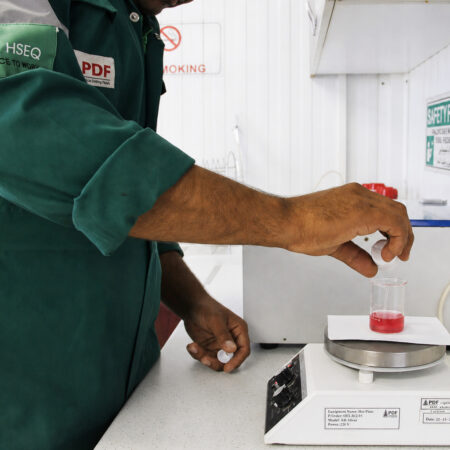
We can provide a wide range of laboratory services for use in waste management projects for on-site water treatment and environmental analysis.
On-site Laboratory analysis is consist of:
- Salinity
- pH
- Hardness
- Ions Such as: Aluminum, Sulfate , Nitrate, Nitrite , etc.
- Turbidity
- Suspended Solid
- BOD (Biological Oxygen Demand)
- COD (Chemical Oxygen Demand)
- Oil Content
and environmental tests of drilling cutting include:
- TCLP
- PAH
- Leakage
- Can Test
- Sheen Test
Total Fluids Management & Monitoring
The first step in waste management services is to identify the resources, type, and volume of waste in the systems, followed by integrated fluid management of production, consumption, and discharge.
What we do in the total fluid management system:
- Design and manufacture of environmentally friendly fluids
- Monitoring effects on technical and environmental performance during use
- Monitoring the performance of operators and fluid recovery equipment, and reusing the fluid
- Control of fluid and waste discharge and storage management, and final treatment for the water supply
- Monitoring tests on site to ensure proper performance
Environmental Solution
Our environmental solution services provide comprehensive, sustainable solutions for the safe handling, treatment, and disposal of drilling fluids and associated oilfield waste. We help minimize environmental impact through efficient waste segregation, recovery, recycling, treatment, and responsible disposal practices, while supporting compliance with applicable environmental regulations.
Our services are designed to reduce waste volumes, recover valuable materials where possible, optimize operational efficiency, and promote environmentally responsible drilling operations from wellsite to final disposal.
